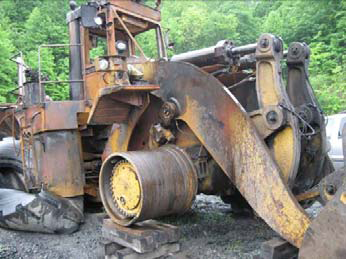
Off-Road Tire Fires

Two recent fires occurred that involved front-end loaders. These fires proved very dangerous to miners and fire fighters because the off-road tires exploded, resulting in a dangerous release of energy. Large off-road tires can throw debris 900 feet when they explode. Although the exploding tires did not injure anyone during these accidents, one front-end loader operator received burns and injuries when he jumped from the loader

Click here for: Safety Flyer (pdf)

1st Anniversary of Roundtable Meetings

It was a beautiful day to be outside and those who attended the CSS Roundtable meeting enjoyed it along with coffee, pastries, and conversation… and a reclaimed mine tour as well. Participants had some good discussion on MSHA, the new Mine Safety legislation for coal and gassy underground MNM mines, training plans, effective training, the National Joseph A Holmes meeting, and more for about an hour. Then we all walked down to the old sand mine on the property of the Ephrata Township Park and continued the discussion with conversation on mine reclamation, DEP mining issues, and tried to volunteer one another to find out how deep the water was.

Though not always held at a park, the Roundtables are held every quarter and sponsored by Complete Safety Solutions. Anyone is welcome to attend. Details on the next one appear about a month before and you can sign up here.

Mine Safety Personnel, Contractors, and DEP Representatives share stories and ideas for improving safety in mining at the Complete Safety Solutions quarterly safety roundtable.

Fatality #40 for Coal Mining 2010

COAL MINE FATALITY – On Thursday, July 1, 2010, a 60-year old section electrician was fatally injured when he was run over by a shuttle car. The victim was last seen walking outby the face in a connecting crosscut. As the loaded shuttle car was leaving the continuous miner, the victim was discovered under the shuttle car.

Best Practices

  • Always sound the shuttle car alarm or bell when approaching and before traveling through check curtains.
  • Be aware of your location in relation to movement of equipment, especially in lower coal seams.
  • Wear reflective or florescent clothing to aid visibility when working around mobile equipment.
  • Train miners to use effective means of communication between themselves and equipment operators.
  • Develop and follow standard operating procedures for tramming shuttle cars.
  • Ensure all personnel are clear of the traveling path and turning radius before moving equipment.
  • Pursue new technology such as proximity detection to protect personnel and eliminate accidents of this type.

Click here for: MSHA Preliminary Report (pdf), MSHA Investigation Report (pdf)

Events Tab Added

Hey look up. Right at the top of this web page. I’ve added a new tab for Events. Here you’ll find great events like workshops, seminars, and other special events to increase your knowledge of what it takes to be safe and network with other safety professionals and like-minded folk.

Check it out. I’ll keep posting good stuff there and if you have your own non-commercial event to publicize let me know. Click on the Contact Me tab to do that.

Fatality #39 for Coal Mining 2010

On June 24, 2010, a 29 year old continuous mining machine operator with 12 years experience received fatal injuries when he was caught between the right rib and the remote controlled continuous mining machine he was operating.

Best Practices
     

  • Install MSHA approved Proximity Detection Systems on continuous mining machines.
    http://www.msha.gov/Accident_Prevention/...
  • Avoid “Red Zone” areas associated with remote controlled continuous mining machines and other mobile equipment.
    http://www.msha.gov/webcasts/coal2004/REDZONE2.pdf
  • Ensure equipment is being operated safely, especially in low mining heights, and slippery and uneven floor conditions.
  • Maintain equipment in a safe operating condition.
  • Observe work practices and provide timely feedback.
  •  

Click here for: MSHA Preliminary Report (pdf), Spanish Fatalgram (pdf), MSHA Investigation Report (pdf).

Links to Fatalgrams in Spanish!

Thanks to John Henderson, the Program Manager at the Texas Mine Safety and Health Program at the University of Texas at Austin for pointing me to some great resources on their site. I’ll be posting them on the Resources page as well as integrating some right into the blog. For example, they translate the MSHA MNM Fatalgrams into Spanish. It’s a great resource if you have any workers who’s native language is Spanish.

You can click here to access their web page and also watch for them with the links that follow the Fatalgrams that are posted here such as Fatality #1 and Fatality #2 from this year. The links from the fatality will, like the links to investigations, etc., be posted as soon as they are available.

Fatality #12 for Metal/Nonmetal Mining 2010

On June 20, 2010, a 52 year-old mechanic with 8 years of experience was fatally injured at a surface copper operation. A ½ ton pickup truck had parked in front of a 240 ton haul truck that was also parked. The haul truck pulled forward and struck the pickup truck fatally injuring the driver and seriously injuring another miner.

Best Practices

  • Do not park smaller vehicles in a large truck’s potential path of movement.
  • Before moving mobile equipment, be certain no one is in the intended path, sound the horn to warn possible unseen persons, and wait to give them time to move to a safe location.
  • Ensure all persons are trained to recognize work place hazards, specifically the limited visibility and blind areas inherent to operation of large equipment and the hazard of mobile equipment traveling near them.
  • Establish procedures that require smaller vehicles to maintain a safe distance from large mobile equipment until eye contact is made or approval to move closer is obtained from the mobile equipment operator. Provide training in these procedures.
  • Install cameras and collision avoidance systems on large trucks to protect persons.
  • Regularly monitor work practices and reinforce the importance of them. Take immediate action to correct unsafe conditions or work practices.

Click here for: MSHA Preliminary Report (pdf), MSHA Investigation Report (pdf), Overview(powerpoint), Overview(pdf), Spanish Fatalgram (pdf)

Safety Roundtable

If you’re in the southeast/south central part of Pennsylvania and want to gather for a couple of hours with safety-minded folks in the mining and construction industry you’re invited to attend one of our quarterly meetings. This month we’re gathering at a local park that was reclaimed from a sand mine. You can find an invite at http://bit.ly/1007roundtable .

There’s no cost, but I ask that you register here so we know you’re coming.

Fatality #11 for Metal/Nonmetal Mining 2010

On June 18, 2010, a 29 year-old contract miner with 6 years of experience was fatally injured at an underground silver mine. The victim was scaling loose ground in a stope when he was struck by falling material approximately 3½ feet long by 2½ feet wide by 2 feet thick.

Best Practices

  • Examine, sound, and test for loose ground in areas before starting to work, after blasting, and as ground conditions warrant.
  • Train all persons to scale loose material safely.
  • Communicate unsafe ground conditions to all affected miners.
  • Perform manual scaling from a location which will not expose persons to injury from falling material.
  • When manually scaling, use scaling bars of a length and design that will allow the removal of loose material without exposing persons to the risk of injury.
  • Install ground support where conditions warrant.

Click here for: MSHA Preliminary Report (pdf), MSHA Investigation Report (pdf), Overview (powerpoint), Overview (pdf), Spanish Fatalgram (pdf)

Fatality #38 for Coal Mining 2010

On Wednesday, June 16, 2010, a 42 year old Section Foreman with 17 years of mining experience was fatally injured. While he was installing rib support, a section of rib 12 feet wide x 15 feet 6 inches high x 9 feet thick fell, knocking over a roof jack that struck him.

Best Practices

  • Conduct roof evaluations when entering a previously mined area for the purpose of pillar recovery.
  • Support loose ribs or roof adequately or scale down material before beginning work.
  • Conduct thorough pre-shift examinations and on-shift examinations of the roof, face, and ribs immediately before work or travel is in an area and thereafter as conditions warrant.
  • Know and follow the approved roof control plan. Take additional measures to protect persons if unusual hazards are encountered.
  • Assure the roof control plan is suitable for prevailing geologic conditions. Revise the plan if conditions change and the support system is not adequate to control the roof, face, and ribs.
  • Be alert to changing geological conditions which may affect roof, rib, and face conditions.

Click here for: MSHA Preliminary Report (pdf), MSHA Investigation Report (pdf), Spanish Fatalgram (pdf)