MSHA to kick off annual ‘Stay Out – Stay Alive’ public safety campaign

ARLINGTON, Va. – The U.S. Department of Labor’s Mine Safety and Health Administration, along with Kansas City Chiefs running back Thomas Jones, will kick off its annual “Stay Out – Stay Alive” public safety campaign on Friday, May 6. Jones, the son of coal miners from southwestern Virginia, is the national spokesman for “Stay Out – Stay Alive,” which was established in 1999 to warn outdoor enthusiasts – especially children – about the dangers of exploring and playing on mine property. Each year, dozens of people are injured or killed in recreational accidents at active and abandoned mines around the country.

Jones will take part in a media conference call with MSHA Assistant Secretary Joseph A. Main and then visit a Crofton, Md., elementary school to address students.

Prior to these May 6 activities, Jones is scheduled to meet on May 5 with various members of Congress to discuss his role as campaign spokesman.

Click here for: Stay Out Stay Alive Web Page

Partnership Produces Resources for Aggregate Miners and Contractors

MSHA and the National Stone, Sand and Gravel Association have teamed up to produce a web page on MSHA’s site that provides everything an aggregate miner or contractor needs to know… even if the disclaimer is needed to say it’s still your responsibility to be sure you are compliant in every way. It’s SAFETY PRO IN A BOX!

These are not new materials, but it’s certainly helpful to have them accessible from one page, something SafeMiner.com tries to do all the time. There are Web Education and Training Resources, Paperwork Requirements, and links to MSHA Handbooks, the Instructor Guide Series, Streaming Media Clips, and more!

But why am I telling you what’s there when you can check it out here!

Now about whether you can actually put a Safety Professional in a box or not without providing confined space training… Ha! SafeMiners.com will provide a permanent link to the site under our Resources Tab, so you can always find one in a box if yours is out wandering around.

MSHA Provides Winter Alert Materials

The annual Winter Alert is ON! “Conditions at underground and surface coal mines can change dramatically during the winter months,” said Joseph A. Main, assistant secretary of labor for mine safety and health. “We must be ever mindful of the seasonal changes that can affect our work environments.”

Posters, decals, and a PowerPoint presentation focus on some underground issues, but a printable poster for surface is also available on the MSHA web site at http://www.msha.gov/FocusOn/WinterAlert2010/WinterAlert2010homepage.asp. Check it out!

CDC’s LEAN Works! Leading Employees to Activity and Nutrition

FREE web-based resource that offers interactive tools and evidence-based resources to design effective worksite obesity prevention and control programs, including an obesity cost calculator to estimate how much obesity is costing your company and how much savings your company could reap with different workplace interventions.
Includes some good health related materials like tips for healthy snacks at meetings and links to state programs where they exist.

Check it out at www.cdc.gov/leanworks

CAT Forklift Safety Brochure

CAT has some really nice safety materials free for the asking or as it goes on the internet, free for the taking. The one this illustration comes from nicely covers the general hazards of operating just about any kind of forklift.

It includes Safety Information for Operators, a sample Pre-operation checklist, and Information for Employers which applies specifically to OSHA regulations, but certainly addresses best practices concerning task training on MSHA sites with such equipment.

Download the PDF, print it out, and use it for a toolbox talk for operators or anyone who works were forklifts are used.

To supplement it you may want to use the fatalgram and investigation for a Coal fatality that involved such a piece of equipment. It happened on the surface of an underground mine, but the hazards apply to just about any mining or construction site.

Click here for: CAT Forklift Trifold (pdf)

MSHA Safety Alert

MSHA has issued an alert to call attention to the fatalities that have occurred other than those at Upper Big Branch which of course has received much attention.  A variety of posters are available on the MSHA site.

“Eight miners are dead because they were struck-by moving or falling objects. Roof falls and rib rolls crushed 7 miners. Six miners were killed working in close proximity to mining or haulage equipment. Three more miners lost their lives in explosions and fires; another miner was killed when he was caught inside rotating machinery; a contract miner fell to his death, a contract truck driver was killed when his truck went through a berm and over a highwall, and a miner drowned. Eight of the dead miners were contractors. Each life lost is a tragedy for a family, a mining operation, and a community.” – from the statement by Joe Main.

Click here for: MSHA Page with Links to Posters

Off-Road Tire Fires

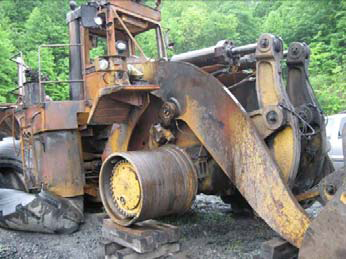
Two recent fires occurred that involved front-end loaders. These fires proved very dangerous to miners and fire fighters because the off-road tires exploded, resulting in a dangerous release of energy. Large off-road tires can throw debris 900 feet when they explode. Although the exploding tires did not injure anyone during these accidents, one front-end loader operator received burns and injuries when he jumped from the loader

Click here for: Safety Flyer (pdf)

Caterpillar Seat Belt Replacement

Seat BeltBecause the Caterpillar operator manuals and other literature say that you must replace seat belts after three years, you may have to replace perfectly good seat belts. MSHA can enforce such requirements from manufacturers.

We can debate that for a long time, but let’s start back a step. Are you replacing seat belts when they become damaged or worn? While CAT’s policy may have created this firestorm (which is before the courts somewhere I’m told) it should at least lead us to take a good look and start by replacing seat belts that should be replaced. For that CAT has a very nice little tool. It’s a toolbox talk that provides a checklist that reminds us that it’s more than the webbing that should be examined. You can download the pdf file below. Why not give a copy to each of your operators (CAT equipment or not) and be sure that these lifesaving devices will function when called upon. I’ve also included an online checklist from an Australian aftermarket supplier.

If you are going to replace that seat belt and want to do it with something other than one from the manufacturer, be sure to meet the requirements of 30 CFR 56/57.14130(h) and 56/57.14131(c). They should have a tag on them showing adherence to the latest versions of SAE J386 or SAE J1194 standards. Check out the MSHA links below.

Resources: CAT Seat Belt Toolbox Talk, Seat Belt Safety Checklist, 30 CFR 56/57.14130, 56/57.14131, MSHA 2003 Final Rule seat belt update