Fatality #17 for Metal/Nonmetal Mining 2010

2010 MNM fatality #17On October 7, 2010, a 72 year-old dozer operator with 20 years of experience died at a dimension stone operation. The victim dismounted the dozer he was operating and walked near a haul truck that struck him.

Best Practices

  • Train all persons to stay clear of mobile equipment.
  • Be aware of the location and traffic patterns of mobile equipment in your work area.
  • Never approach mobile equipment until you communicate with mobile equipment operators and receive confirmation from the operator indicating awareness of your presence.
  • Use radios to communicate when visual contact can’t be maintained.
  • Wear high visibility clothing when working around mobile equipment.
  • Install “rear viewing” cameras and proximity detection devices on mobile equipment.
  • Before moving mobile equipment, look in the direction of travel, use all mirrors, cameras, and proximity detection devices to ensure no persons are in the intended path.
  • Sound the horn to warn persons of intended movement and wait to give them time to move to a safe location.

Click here for: MSHA Preliminary Report (pdf), MSHA Investigation Report (pdf), Overview (powerpoint), Overview (pdf).

Fatality #16 for Metal/Nonmetal Mining 2010

MNM Fatality 16 2010

On October 10, 2010, a 42 year- old contract electrician with 4 years of experience was seriously injured at a granite operation. The victim and two co-workers were installing ground fault indicator lights in a circuit breaker enclosure when an arc flash occurred. The circuit breaker enclosure contained a bottom feed circuit breaker. All three workers were hospitalized and the victim died on October 12, 2010.

Before YOU perform electrical work:

  • Be trained on all the electrical tests and safety equipment necessary to safely test and ground the circuit being worked on.
  • Conduct a risk assessment.
  • Use properly rated Personal Protective Equipment (PPE) including Arc Flash Protection such as a hood, gloves, shirt, and pants.
  • Positively identify the circuit on which work is to be conducted.
  • De-energize power and ensure that the circuit is visibly open.
  • Place YOUR lock and tag on the disconnecting device.
  • Verify the circuit is de-energized by testing for voltage using properly rated test equipment.
  • Ensure ALL electrical components in the enclosure are de-energized.
  • Ground ALL phase conductors to the equipment grounding medium with grounding equipment that is properly rated.
  • Install warning labels on the terminal covers of bottom feed circuit breakers stating the “Bottom terminal lugs remain energized when the circuit breaker is open.”

Click here for: MSHA Preliminary Report (pdf), MSHA Investigation Report (pdf), Overview (powerpoint), Overview (pdf).

MSHA Provides Winter Alert Materials

The annual Winter Alert is ON! “Conditions at underground and surface coal mines can change dramatically during the winter months,” said Joseph A. Main, assistant secretary of labor for mine safety and health. “We must be ever mindful of the seasonal changes that can affect our work environments.”

Posters, decals, and a PowerPoint presentation focus on some underground issues, but a printable poster for surface is also available on the MSHA web site at http://www.msha.gov/FocusOn/WinterAlert2010/WinterAlert2010homepage.asp. Check it out!

Fatality #44 for Coal Mining 2010

On Friday, September 3, 2010, a 37-year old Truck Driver with approximately two years experience was killed when the haul truck he was operating struck another truck from behind. The lead truck had stopped short of the pit, while a bulldozer pushed up material for the track-hoe to load. The victim, returning from dumping, ran into the bed of the lead truck.

Best Practices
  • Conduct adequate pre-operational examinations before placing equipment into operation and ensure all lights are operational.
  • Use cab and vehicle marker lights at all times when vehicles are in use during low light conditions, even when stationary/parking.
  • Provide adequate illumination for all work areas where visibility is critical.
  • Maintain control of equipment at all times, making allowances for the prevailing conditions (low visibility, inclement weather, etc).
  • Consider providing proximity detection devices to mobile equipment when the possibility of collision with other mobile equipment is present.
  • Routinely monitor work habits and examine work areas to insure that safe work procedures are followed.
  • Communicate actions and intent to co-workers, especially if non-routine or out of the ordinary.
  • When waiting to be loaded, take the vehicle out of gear and set the parking brake.
  • Stay alert, stay awake, and pay attention to the task.

Click here for: MSHA Preliminary Report (pdf)

Fatality #43 for Coal Mining 2010

Coal Fatality 2010 number 43On August 31, 2010, a 25-year old truck driver, with 16 weeks and 3 days of mining experience, was killed when the truck he was driving left the haulage road. The truck traveled approximately 11 feet up an embankment on the left side of the haulage road, and then abruptly traveled back across the haulage road. Afterwards, the truck impacted a 5 foot high berm, travelled over the berm, and dropped 72 feet to the mine pit below.

Best Practices
  • Conduct pre-operational examinations on all mobile equipment.
  • Do not exceed the truck’s capabilities, operating ranges, load-limits and safety features.
  • Always wear a seatbelt when operating a haul truck or mobile equipment.
  • Adequately task train miners on the equipment they will operate.
  • Post the speed limit, appropriate gear, grade, curve or other warning signage along haulage roads as appropriate.

Click here for: MSHA Preliminary Report (pdf), MSHA Investigation Report (pdf)

Fatality #15 for Metal/Nonmetal Mining 2010

On August 14, 2010, a 23 year-old dredge operator with 4 years of experience died at a sand and gravel dredge operation. The victim and another miner were pulling a small boat from a dredge pond onto a boat trailer attached to a pickup truck. When the boat slipped back into the water, the victim attempted to retrieve it and drowned.

Best Practices
  • Wear a life jacket where there is a danger from falling into water.
  • Review procedures to ensure all possible hazards have been identified and appropriate controls are in place to protect miners before beginning work.
  • Develop procedures for loading and unloading boats in dredge operations and train all persons.
  • Inspect equipment, including the winch and cable, prior to use and maintain in a safe condition.
  • Attach the trailer winch rope securely to the boat prior to removing from the water.
  • Ensure that persons working around water receive training for swimming.

Click here for: MSHA Preliminary Report (pdf), MSHA Investigation Report (pdf), Overview (powerpoint), Overview (pdf)

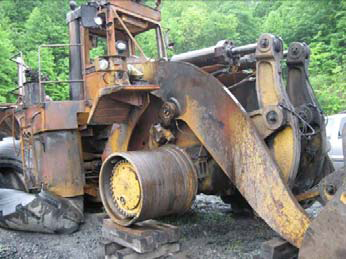
Off-Road Tire Fires

Two recent fires occurred that involved front-end loaders. These fires proved very dangerous to miners and fire fighters because the off-road tires exploded, resulting in a dangerous release of energy. Large off-road tires can throw debris 900 feet when they explode. Although the exploding tires did not injure anyone during these accidents, one front-end loader operator received burns and injuries when he jumped from the loader

Click here for: Safety Flyer (pdf)

Fatality #12 for Metal/Nonmetal Mining 2010

On June 20, 2010, a 52 year-old mechanic with 8 years of experience was fatally injured at a surface copper operation. A ½ ton pickup truck had parked in front of a 240 ton haul truck that was also parked. The haul truck pulled forward and struck the pickup truck fatally injuring the driver and seriously injuring another miner.

Best Practices

  • Do not park smaller vehicles in a large truck’s potential path of movement.
  • Before moving mobile equipment, be certain no one is in the intended path, sound the horn to warn possible unseen persons, and wait to give them time to move to a safe location.
  • Ensure all persons are trained to recognize work place hazards, specifically the limited visibility and blind areas inherent to operation of large equipment and the hazard of mobile equipment traveling near them.
  • Establish procedures that require smaller vehicles to maintain a safe distance from large mobile equipment until eye contact is made or approval to move closer is obtained from the mobile equipment operator. Provide training in these procedures.
  • Install cameras and collision avoidance systems on large trucks to protect persons.
  • Regularly monitor work practices and reinforce the importance of them. Take immediate action to correct unsafe conditions or work practices.

Click here for: MSHA Preliminary Report (pdf), MSHA Investigation Report (pdf), Overview(powerpoint), Overview(pdf), Spanish Fatalgram (pdf)

Fatality #37 for Coal Mining 2010

On Tuesday, June 8, 2010, a 38-year old service truck operator with seven years of mining experience, was fatally injured while in the process of refueling a diesel track-mounted highwall drill. The operator was apparently placing the fuel nozzle into the diesel fuel tank when an ignition/explosion erupted into a fire, engulfing him in flames.

Best Practices

  • Open fuel tank cap slowly to relieve any pressure buildup.
  • Ensure that the refueling area is well ventilated, especially in low areas where heavy fuel vapors can accumulate.
  • Before refueling, turn off the engine(s) and motor(s) and eliminate other potential ignition sources.
  • Check hydraulic lines and connections, especially those near hot surfaces, prior to operating the vehicle. Perform maintenance or repairs when necessary.
  • Ensure that all affected persons are familiar with the Material Safety Data Sheets on fuels and lubricants in use.

Click here for: Spanish Fatalgram (pdf), MSHA Investigation Report (pdf)

Fatality #10 for Metal/Nonmetal Mining 2010

On June 12, 2010, a 46-year-old contractor welder was fatally injured at a crushed stone operation. He was preparing to weld on an overhead ventilation duct. The victim was using a ladder to access the duct when he fell over a handrail approximately 45 feet to the ground.

Best Practices

  • Always use fall protection when working where a fall hazard exists.
  • Position ladders to ensure their stability and to eliminate trip hazards.
  • Always face the ladder when climbing or working from a ladder.
  • Do not lean to reach items while standing on a ladder.
  • Always maintain three points of contact with the ladder when climbing.
Click here for: MSHA Preliminary Report (pdf), MSHA Investigation Report (pdf), Overview (powerpoint), Overview(pdf), Spanish Fatalgram (pdf)