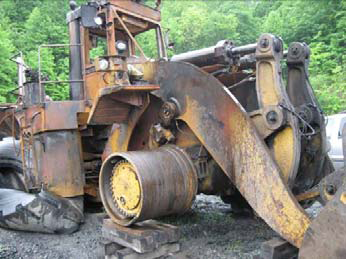
Off-Road Tire Fires

Two recent fires occurred that involved front-end loaders. These fires proved very dangerous to miners and fire fighters because the off-road tires exploded, resulting in a dangerous release of energy. Large off-road tires can throw debris 900 feet when they explode. Although the exploding tires did not injure anyone during these accidents, one front-end loader operator received burns and injuries when he jumped from the loader

Click here for: Safety Flyer (pdf)

Fatality #40 for Coal Mining 2010

COAL MINE FATALITY – On Thursday, July 1, 2010, a 60-year old section electrician was fatally injured when he was run over by a shuttle car. The victim was last seen walking outby the face in a connecting crosscut. As the loaded shuttle car was leaving the continuous miner, the victim was discovered under the shuttle car.

Best Practices

  • Always sound the shuttle car alarm or bell when approaching and before traveling through check curtains.
  • Be aware of your location in relation to movement of equipment, especially in lower coal seams.
  • Wear reflective or florescent clothing to aid visibility when working around mobile equipment.
  • Train miners to use effective means of communication between themselves and equipment operators.
  • Develop and follow standard operating procedures for tramming shuttle cars.
  • Ensure all personnel are clear of the traveling path and turning radius before moving equipment.
  • Pursue new technology such as proximity detection to protect personnel and eliminate accidents of this type.

Click here for: MSHA Preliminary Report (pdf), MSHA Investigation Report (pdf)

Fatality #39 for Coal Mining 2010

On June 24, 2010, a 29 year old continuous mining machine operator with 12 years experience received fatal injuries when he was caught between the right rib and the remote controlled continuous mining machine he was operating.

Best Practices
     

  • Install MSHA approved Proximity Detection Systems on continuous mining machines.
    http://www.msha.gov/Accident_Prevention/...
  • Avoid “Red Zone” areas associated with remote controlled continuous mining machines and other mobile equipment.
    http://www.msha.gov/webcasts/coal2004/REDZONE2.pdf
  • Ensure equipment is being operated safely, especially in low mining heights, and slippery and uneven floor conditions.
  • Maintain equipment in a safe operating condition.
  • Observe work practices and provide timely feedback.
  •  

Click here for: MSHA Preliminary Report (pdf), Spanish Fatalgram (pdf), MSHA Investigation Report (pdf).

Fatality #11 for Metal/Nonmetal Mining 2010

On June 18, 2010, a 29 year-old contract miner with 6 years of experience was fatally injured at an underground silver mine. The victim was scaling loose ground in a stope when he was struck by falling material approximately 3½ feet long by 2½ feet wide by 2 feet thick.

Best Practices

  • Examine, sound, and test for loose ground in areas before starting to work, after blasting, and as ground conditions warrant.
  • Train all persons to scale loose material safely.
  • Communicate unsafe ground conditions to all affected miners.
  • Perform manual scaling from a location which will not expose persons to injury from falling material.
  • When manually scaling, use scaling bars of a length and design that will allow the removal of loose material without exposing persons to the risk of injury.
  • Install ground support where conditions warrant.

Click here for: MSHA Preliminary Report (pdf), MSHA Investigation Report (pdf), Overview (powerpoint), Overview (pdf), Spanish Fatalgram (pdf)

Fatality #38 for Coal Mining 2010

On Wednesday, June 16, 2010, a 42 year old Section Foreman with 17 years of mining experience was fatally injured. While he was installing rib support, a section of rib 12 feet wide x 15 feet 6 inches high x 9 feet thick fell, knocking over a roof jack that struck him.

Best Practices

  • Conduct roof evaluations when entering a previously mined area for the purpose of pillar recovery.
  • Support loose ribs or roof adequately or scale down material before beginning work.
  • Conduct thorough pre-shift examinations and on-shift examinations of the roof, face, and ribs immediately before work or travel is in an area and thereafter as conditions warrant.
  • Know and follow the approved roof control plan. Take additional measures to protect persons if unusual hazards are encountered.
  • Assure the roof control plan is suitable for prevailing geologic conditions. Revise the plan if conditions change and the support system is not adequate to control the roof, face, and ribs.
  • Be alert to changing geological conditions which may affect roof, rib, and face conditions.

Click here for: MSHA Preliminary Report (pdf), MSHA Investigation Report (pdf), Spanish Fatalgram (pdf)

Fatality #9 for Metal/Nonmetal Mining 2010

On May 28, 2010, a 59-year-old supervisor with 20 years of experience was fatally injured at an underground gold mine. The victim and another miner entered a blast area when a misfire detonated without warning. The other miner was injured and hospitalized.

Best Practices

  • Follow the manufacturers’ guidelines for the storage and usage of explosives.
  • Keep explosives storage areas clean, dry and orderly.
  • Properly rotate explosive stock to use oldest stock first.
  • Never use damaged/deteriorated/outdated explosives, initiation devices, or blasting agents.
  • Wait a minimum of the required times before entering the blast area when either a misfire and/or burning explosives are a possibility.

Click here for: MSHA Investigation Report (pdf), Overview (powerpoint), Overview (pdf),  Spanish Fatalgram (pdf)

Fatality #8 for Metal/Nonmetal Mining 2010

On May 26, 2010, a 28 year-old contract miner with 10 weeks of mining experience was fatally injured at an underground uranium mine. The victim was scaling a rib when he was struck by falling material approximately 11 feet high, 15 feet wide and 4 inches to 30 inches thick.

Best Practices

  • Always examine, sound and test for loose ground in areas before starting to work, after blasting, and as ground conditions warrant.
  • Train all persons to scale loose material safely.
  • Always perform manual scaling from a safe location.
  • When manually scaling, use scaling bars of a length and design that allow the removal of loose material without exposing the persons performing the work.
  • Install ground support in ribs where conditions warrant.

Click here for: MSHA Investigation Report (pdf), Overview (powerpoint), Overview (pdf), Spanish Fatalgram (pdf)

Fatality #36 for Coal Mining 2010

On Monday, May 10, 2010, a 55 year old continuous mining machine operator, with approximately 37 years of mining experience, received crushing injuries when he was pinned between a shuttle car and a coal rib. As the loaded shuttle car turned into the last open crosscut, the victim was positioned in the outside turn radius of the shuttle car and was crushed between the shuttle car and the coal rib. The victim passed away on Friday, May 21, 2010 while hospitalized.

Best Practices

  • Make a visual check to ensure all persons are in the clear, and sound the warning device before mobile equipment is trammed, especially in areas where visibility is limited.
  • Ensure good communication between continuous mining machine operators and shuttle car operators so that each is aware of each other’s movements.
  • Wear reflective clothing to aid visibility when working around mobile equipment.
  • Use approved translucent curtains made to allow mobile equipment to tram through.

Click here for: MSHA Investigation Report (pdf)

Most Roof Failures Occur During Warmer Weather

ARLINGTON, Va. – The U.S. Department of Labor’s Mine Safety and Health Administration this week launched its annual roof fall prevention awareness program aimed at reducing the high number of roof falls that occur in the nation’s underground coal mines. Statistics show that more accidents and injuries from roof falls occur during the summer months than at any other time of year. As temperatures rise, humidity and moisture increase underground, making it easier for a mine roof or rib to fall.
“Underground roof falls continue to be a leading cause of coal mining fatalities,” said Joseph A. Main, assistant secretary of labor for mine safety and health. “Miners and mine operators are urged to pay attention to roof conditions – not just in summer, but throughout the year.”
Since 2000, there have been 69 coal mining fatalities attributed to “fall of roof or back and fall of face/rib/pillar/side/highwall.” During the agency’s Preventive Roof/Rib Outreach Program, also known as PROP, which runs through September, MSHA personnel will advise operators to examine roof that has weathered due to humid air; communicate immediately with miners when they observe adverse roof conditions; install supplemental support when conditions warrant; scale loose roof in the face area where miners work; and consistently follow the approved roof control plan for their mines.
Beginning this week, federal mine inspectors will distribute educational information including posters and hardhat stickers to remind the coal industry about potential hazards and suggested remedies. MSHA officials will speak directly to miners about the problems warmer weather causes for underground mines and present them with pertinent statistics about the increase in accidents during the warmer weather months.

Click here for: MSHA Press Release (pdf), PROP page

Fatality #34 & 35 for Coal Mining 2010

On April 28, 2010, the mine roof collapsed at approximately 10:00 p.m., resulting in fatal injuries to a 27-year old continuous miner operator with 3.5 years total mining experience and a 28-year old miner helper with 2 years total mining experience. The roof fall occurred while the miners were loading rock out of a completed extended cut. The fall measured a maximum of 19’9″ in width and 10′ in height. The length of the fall was approximately 70 to 75′ in length, extending toward the face.

Best Practices

  • Assess and examine the adequacy of roof control systems and mining layout for local geology. Know and follow the approved roof control plan.
  • Always conduct a thorough visual examination of the roof, face and ribs immediately before work is performed and thereafter as conditions dictate.
  • When adverse or subnormal roof conditions are present, the mining cut depth should be limited to 20 feet or less. Be alert to changing roof conditions at all times.
  • Ensure that any past roof control issues or history of adverse conditions in adjacent previously mined areas are communicated to all miners and foremen.

Click here for: MSHA Investigation Report (pdf)