Fatality #43 for Coal Mining 2010

Coal Fatality 2010 number 43On August 31, 2010, a 25-year old truck driver, with 16 weeks and 3 days of mining experience, was killed when the truck he was driving left the haulage road. The truck traveled approximately 11 feet up an embankment on the left side of the haulage road, and then abruptly traveled back across the haulage road. Afterwards, the truck impacted a 5 foot high berm, travelled over the berm, and dropped 72 feet to the mine pit below.

Best Practices
  • Conduct pre-operational examinations on all mobile equipment.
  • Do not exceed the truck’s capabilities, operating ranges, load-limits and safety features.
  • Always wear a seatbelt when operating a haul truck or mobile equipment.
  • Adequately task train miners on the equipment they will operate.
  • Post the speed limit, appropriate gear, grade, curve or other warning signage along haulage roads as appropriate.

Click here for: MSHA Preliminary Report (pdf), MSHA Investigation Report (pdf)

Fatality #41 for Coal Mining 2010

diagram of coal fatality number 41 for 2010On Friday, July 9, 2010, a 61-year old production foreman with 33 years mining experience was fatally injured when he was struck by a battery-powered ram car. The victim was last seen in the No. 6 entry just outby the intersection at crosscut No. 107. This intersection and adjoining crosscuts were being used to gain access to the ratio feeder located in the No. 5 entry.

Best Practices
  • Install proximity detection systems on mobile face equipment. See the proximity detection single source page on the MSHA web site.
  • Use approved translucent check curtains designed to allow mobile equipment to tram through.
  • Sound audible warnings when making turns, reversing directions, approaching ventilation curtains, and any time the operator’s visibility is obstructed. The sound level of audible warnings must be significantly higher than that of ambient noise.
  • Be aware of blind spots when travelling in mobile equipment travel ways.
  • Communicate your position and intended movements to mobile equipment operators.

Click here for: MSHA Preliminary Report (pdf), MSHA Investigation Report (pdf)

Off-Road Tire Fires

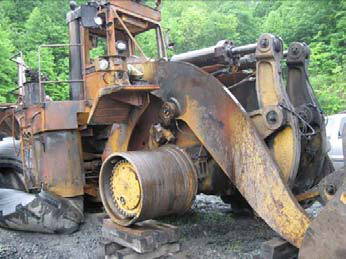
Two recent fires occurred that involved front-end loaders. These fires proved very dangerous to miners and fire fighters because the off-road tires exploded, resulting in a dangerous release of energy. Large off-road tires can throw debris 900 feet when they explode. Although the exploding tires did not injure anyone during these accidents, one front-end loader operator received burns and injuries when he jumped from the loader

Click here for: Safety Flyer (pdf)

Fatality #40 for Coal Mining 2010

COAL MINE FATALITY – On Thursday, July 1, 2010, a 60-year old section electrician was fatally injured when he was run over by a shuttle car. The victim was last seen walking outby the face in a connecting crosscut. As the loaded shuttle car was leaving the continuous miner, the victim was discovered under the shuttle car.

Best Practices

  • Always sound the shuttle car alarm or bell when approaching and before traveling through check curtains.
  • Be aware of your location in relation to movement of equipment, especially in lower coal seams.
  • Wear reflective or florescent clothing to aid visibility when working around mobile equipment.
  • Train miners to use effective means of communication between themselves and equipment operators.
  • Develop and follow standard operating procedures for tramming shuttle cars.
  • Ensure all personnel are clear of the traveling path and turning radius before moving equipment.
  • Pursue new technology such as proximity detection to protect personnel and eliminate accidents of this type.

Click here for: MSHA Preliminary Report (pdf), MSHA Investigation Report (pdf)

Fatality #12 for Metal/Nonmetal Mining 2010

On June 20, 2010, a 52 year-old mechanic with 8 years of experience was fatally injured at a surface copper operation. A ½ ton pickup truck had parked in front of a 240 ton haul truck that was also parked. The haul truck pulled forward and struck the pickup truck fatally injuring the driver and seriously injuring another miner.

Best Practices

  • Do not park smaller vehicles in a large truck’s potential path of movement.
  • Before moving mobile equipment, be certain no one is in the intended path, sound the horn to warn possible unseen persons, and wait to give them time to move to a safe location.
  • Ensure all persons are trained to recognize work place hazards, specifically the limited visibility and blind areas inherent to operation of large equipment and the hazard of mobile equipment traveling near them.
  • Establish procedures that require smaller vehicles to maintain a safe distance from large mobile equipment until eye contact is made or approval to move closer is obtained from the mobile equipment operator. Provide training in these procedures.
  • Install cameras and collision avoidance systems on large trucks to protect persons.
  • Regularly monitor work practices and reinforce the importance of them. Take immediate action to correct unsafe conditions or work practices.

Click here for: MSHA Preliminary Report (pdf), MSHA Investigation Report (pdf), Overview(powerpoint), Overview(pdf), Spanish Fatalgram (pdf)

Caterpillar Seat Belt Replacement

Seat BeltBecause the Caterpillar operator manuals and other literature say that you must replace seat belts after three years, you may have to replace perfectly good seat belts. MSHA can enforce such requirements from manufacturers.

We can debate that for a long time, but let’s start back a step. Are you replacing seat belts when they become damaged or worn? While CAT’s policy may have created this firestorm (which is before the courts somewhere I’m told) it should at least lead us to take a good look and start by replacing seat belts that should be replaced. For that CAT has a very nice little tool. It’s a toolbox talk that provides a checklist that reminds us that it’s more than the webbing that should be examined. You can download the pdf file below. Why not give a copy to each of your operators (CAT equipment or not) and be sure that these lifesaving devices will function when called upon. I’ve also included an online checklist from an Australian aftermarket supplier.

If you are going to replace that seat belt and want to do it with something other than one from the manufacturer, be sure to meet the requirements of 30 CFR 56/57.14130(h) and 56/57.14131(c). They should have a tag on them showing adherence to the latest versions of SAE J386 or SAE J1194 standards. Check out the MSHA links below.

Resources: CAT Seat Belt Toolbox Talk, Seat Belt Safety Checklist, 30 CFR 56/57.14130, 56/57.14131, MSHA 2003 Final Rule seat belt update

Fatality #36 for Coal Mining 2010

On Monday, May 10, 2010, a 55 year old continuous mining machine operator, with approximately 37 years of mining experience, received crushing injuries when he was pinned between a shuttle car and a coal rib. As the loaded shuttle car turned into the last open crosscut, the victim was positioned in the outside turn radius of the shuttle car and was crushed between the shuttle car and the coal rib. The victim passed away on Friday, May 21, 2010 while hospitalized.

Best Practices

  • Make a visual check to ensure all persons are in the clear, and sound the warning device before mobile equipment is trammed, especially in areas where visibility is limited.
  • Ensure good communication between continuous mining machine operators and shuttle car operators so that each is aware of each other’s movements.
  • Wear reflective clothing to aid visibility when working around mobile equipment.
  • Use approved translucent curtains made to allow mobile equipment to tram through.

Click here for: MSHA Investigation Report (pdf)

Fatality #4 for Metal/Nonmetal Mining 2010

On March 24, 2010, a 63 year-old contract truck driver with 21 years of experience was fatally injured at a surface area of an underground salt mine. The victim was loading his truck under a 150 ton salt bin when it collapsed, falling onto the cab of the truck. A second victim working in the area received serious injuries.

Best Practices

  • Routinely examine metal structures for indications of weakened structural soundness (corrosion, fatigue cracks, bent/buckling beams, braces or columns, loose/missing connectors, broken welds, etc.).
  • Keep corrosive material spillage/build-up removed from metal structures.
  • Report all areas where indications of structural weakness are found.

Click here for: MSHA Investigation Report(pdf), Overview(powerpoint), Overview(pdf)

Fatality #2 for Metal/Nonmetal Mining 2010

On January 26, 2010, a 59 year-old purchasing manager with 5 years of experience was fatally injured at a cement operation. The victim was struck by an over-the-road tandem trailer truck. The truck had been waiting to unload. When the truck pulled forward, another truck driver observed the victim under the second trailer of the truck and immediately stopped the driver. The victim was holding a cell phone at the time of the accident.

Best Practices

  • Train all persons to stay clear of mobile equipment.
  • Be aware of the location and traffic patterns of mobile equipment in your work area.
  • Communicate with mobile equipment operators and ensure they acknowledge your presence.
  • Never approach mobile equipment until you receive confirmation from the operator indicating awareness of your presence.
  • Wear high visibility clothing when working around mobile equipment.
  • Avoid distractions, such as cell phones, when exposed to hazards.
  • Before moving mobile equipment, look in the direction of travel, use all mirrors, cameras, and installed proximity detection devices to ensure no persons are in the intended path.
  • Sound the horn to warn persons of intended movement and wait to give them time to move to a safe location.

Click here for: MSHA Investigation Report(pdf), Overview(powerpoint), Overview(pdf), Spanish Fatalgram(doc)