Fatality #47 for Coal Mining 2010

On Tuesday, November 23, 2010, a 32-year old service man with 6 years of experience, was killed at a surface mine. The victim was driving a tandem axle lube truck down a grade into an active work area of the mine when he lost control of the truck. The truck struck an embankment and overturned onto its left side. The victim either jumped or was thrown from the truck.

Best Practices

  • Conduct pre-operational safety checks of all mobile equipment.
  • Equipment defects affecting safety shall be corrected before the equipment is used.
  • Always wear a seat belt when operating a truck or mobile equipment.
  • Maintain adequate berms on the outer banks of elevated roadways.
  • Construct haulage roads to grade and lane widths appropriate for all equipment used.
  • Train all employees on proper operation procedures, hazard recognition, and avoidance.
  • Ensure traffic rules, signals, and warning signs are posted and obeyed.
  • Maintain equipment braking and steering systems in good repair and adjustment.
  • Do not exceed the truck’s capabilities, operating ranges, load-limits and safety features.
  • Operate vehicles in the appropriate gear and avoid changing gears when descending grades.
  • Ensure there is sufficient illumination of working areas and lights are maintained on mobile equipment.
  • Do not exit or jump from a moving vehicle.

For more information to prevent these types of accidents click on the following link:
MSHA – Safety Targets Program – Operating Surface Equipment (Coal) Safety Target Package

Click here for: MSHA Preliminary Report (pdf), MSHA Investigation Report (pdf)

Fatality #46 for Coal Mining 2010

On Wednesday, October 27, 2010, 39-year old continuous mining machine helper, with approximately 4 years of mining experience, was killed when he was struck by a loaded shuttle car. The victim was in the No.7 Entry between crosscuts No.37 and No.38, repairing a ventilation curtain. This entry and adjoining crosscuts were being used to gain access to the ratio feeder, which was located in the No.6 Entry.

Best Practices

  • Before performing work in an active haulage travelway, stop mobile equipment until work has been completed and communicate your position and intended movements to mobile equipment operators.
  • Use approved transparent ventilation curtains to improve visibility.
  • Operate mobile equipment at safe speeds and sound audible warnings when making turns, reversing directions, approaching ventilation curtains, and any time the operator’s visibility is obstructed. The sound level of audible warnings must be significantly higher than that of ambient noise.
  • Place visible warning devices at all entrances to areas where work is to be performed in the active travelway of mobile equipment.
  • Be aware of blind spots when traveling in the same areas where mobile equipment operates.
  • Install proximity detection systems on mobile face equipment.
  • Always wear reflective clothing, or use permissible personal flashing lights, to ensure high visibility when necessary to walk or work where moving equipment operates.

For more information related to struck-by equipment accidents view the following link: MSHA – Safety Targets Program – Hit By Underground Equipment at www.msha.gov.

Click here for: MSHA Preliminary Report (pdf)

Fatality #20 for Metal/Nonmetal Mining 2010

On November 13, 2010, a 42 year- old contract mechanic with 23 years of experience died at a sand and gravel operation. The victim was underneath a front-end loader, with the engine running, checking a hydraulic fluid leak when the machine moved and rolled over him. The machine was parked on a slight grade, the bucket was raised off the ground, and no wheel chocks were in place.

Best Practices

  • Train persons to recognize work place hazards.
  • Establish safe work procedures before a task is performed and ensure that the safe work procedures are followed.
  • Set the park brake and securely block equipment and components against hazardous motion at all times while performing repair or maintenance work.
  • Do not rely on hydraulic systems to hold mobile equipment stationary during repairs or maintenance.
  • Lower the bucket to the ground when parking mobile equipment.

Click here for: MSHA Preliminary Report (pdf), MSHA Investigation Report(pdf), Overview(powerpoint), Overview (pdf).

Fatality #19 for Metal/Nonmetal Mining 2010

mnm fatality number 19 for 2010On October 20, 2010, a 63 year- old contract truck driver with 41 years of experience died at a fuller’s earth (clay) operation. The victim backed his trailer into a bay at the mine loading dock. He got out of his truck and walked to an adjacent bay to discuss the loading procedures with the fork lift operator. At that time, a second trailer was being moved into the bay and it struck the victim, pinning him against the loading dock.

Best Practices

  • Establish a control policy that includes signs directing all truck drivers to report to a designated office clear of the dock and truck travel areas when dropping or picking up loads.
  • Train all persons to recognize work place hazards and to stay clear of normal paths of travel of mobile equipment.
  • Provide a clearly marked, safe area for pedestrian access to the facility. Clearly mark areas that are unsafe for pedestrian access and prevent entry into those areas.
  • Ensure that illumination is sufficient at the work site.
  • Before moving mobile equipment, look in the direction of travel, use all mirrors, cameras, backup alarms, and installed proximity detection devices to ensure no one is in the intended path.
  • Sound the horn to warn persons of movement and wait to give them time to get to a safe location.
  • Communicate with mobile equipment operators and ensure they acknowledge your presence.
  • Wear high visibility clothing when working around mobile equipment.

Click here for: MSHA Preliminary Report (pdf), MSHA Investigation Report (pdf), Overview(powerpoint), Overview (pdf).

Fatality #18 for Metal/Nonmetal Mining 2010

2010 MNM Fatality 18On October 16, 2010, a 52 year- old haul truck driver with 5 years of experience died at a crushed stone operation. He was using an air-powered hammer/chisel to clean hardened material on a belt conveyor tail pulley. The victim was positioned on top of the return side of the belt conveyor, facing the tail pulley, when the belt conveyor was energized, entangling him in the tail pulley.

Best Practices

  • Deenergize and block belt conveyors against motion before working near a drive, head, tail, and take-up pulleys.
  • Lock-out/tag-out all energy sources to belt conveyors before working on them.
  • Establish policies and procedures for conducting specific tasks on belt conveyors.
  • Ensure that persons are task trained and understand the hazards associated with the work being performed.
  • Maintain communications with all persons performing the task. Before re-starting belt conveyors, ensure that all persons are clear.

Click here for: MSHA Preliminary Report (pdf), MSHA Investigation Report (pdf), Overview(powerpoint), Overview (pdf).

Fatality #17 for Metal/Nonmetal Mining 2010

2010 MNM fatality #17On October 7, 2010, a 72 year-old dozer operator with 20 years of experience died at a dimension stone operation. The victim dismounted the dozer he was operating and walked near a haul truck that struck him.

Best Practices

  • Train all persons to stay clear of mobile equipment.
  • Be aware of the location and traffic patterns of mobile equipment in your work area.
  • Never approach mobile equipment until you communicate with mobile equipment operators and receive confirmation from the operator indicating awareness of your presence.
  • Use radios to communicate when visual contact can’t be maintained.
  • Wear high visibility clothing when working around mobile equipment.
  • Install “rear viewing” cameras and proximity detection devices on mobile equipment.
  • Before moving mobile equipment, look in the direction of travel, use all mirrors, cameras, and proximity detection devices to ensure no persons are in the intended path.
  • Sound the horn to warn persons of intended movement and wait to give them time to move to a safe location.

Click here for: MSHA Preliminary Report (pdf), MSHA Investigation Report (pdf), Overview (powerpoint), Overview (pdf).

Fatality #44 for Coal Mining 2010

On Friday, September 3, 2010, a 37-year old Truck Driver with approximately two years experience was killed when the haul truck he was operating struck another truck from behind. The lead truck had stopped short of the pit, while a bulldozer pushed up material for the track-hoe to load. The victim, returning from dumping, ran into the bed of the lead truck.

Best Practices
  • Conduct adequate pre-operational examinations before placing equipment into operation and ensure all lights are operational.
  • Use cab and vehicle marker lights at all times when vehicles are in use during low light conditions, even when stationary/parking.
  • Provide adequate illumination for all work areas where visibility is critical.
  • Maintain control of equipment at all times, making allowances for the prevailing conditions (low visibility, inclement weather, etc).
  • Consider providing proximity detection devices to mobile equipment when the possibility of collision with other mobile equipment is present.
  • Routinely monitor work habits and examine work areas to insure that safe work procedures are followed.
  • Communicate actions and intent to co-workers, especially if non-routine or out of the ordinary.
  • When waiting to be loaded, take the vehicle out of gear and set the parking brake.
  • Stay alert, stay awake, and pay attention to the task.

Click here for: MSHA Preliminary Report (pdf)

Fatality #43 for Coal Mining 2010

Coal Fatality 2010 number 43On August 31, 2010, a 25-year old truck driver, with 16 weeks and 3 days of mining experience, was killed when the truck he was driving left the haulage road. The truck traveled approximately 11 feet up an embankment on the left side of the haulage road, and then abruptly traveled back across the haulage road. Afterwards, the truck impacted a 5 foot high berm, travelled over the berm, and dropped 72 feet to the mine pit below.

Best Practices
  • Conduct pre-operational examinations on all mobile equipment.
  • Do not exceed the truck’s capabilities, operating ranges, load-limits and safety features.
  • Always wear a seatbelt when operating a haul truck or mobile equipment.
  • Adequately task train miners on the equipment they will operate.
  • Post the speed limit, appropriate gear, grade, curve or other warning signage along haulage roads as appropriate.

Click here for: MSHA Preliminary Report (pdf), MSHA Investigation Report (pdf)

Fatality #41 for Coal Mining 2010

diagram of coal fatality number 41 for 2010On Friday, July 9, 2010, a 61-year old production foreman with 33 years mining experience was fatally injured when he was struck by a battery-powered ram car. The victim was last seen in the No. 6 entry just outby the intersection at crosscut No. 107. This intersection and adjoining crosscuts were being used to gain access to the ratio feeder located in the No. 5 entry.

Best Practices
  • Install proximity detection systems on mobile face equipment. See the proximity detection single source page on the MSHA web site.
  • Use approved translucent check curtains designed to allow mobile equipment to tram through.
  • Sound audible warnings when making turns, reversing directions, approaching ventilation curtains, and any time the operator’s visibility is obstructed. The sound level of audible warnings must be significantly higher than that of ambient noise.
  • Be aware of blind spots when travelling in mobile equipment travel ways.
  • Communicate your position and intended movements to mobile equipment operators.

Click here for: MSHA Preliminary Report (pdf), MSHA Investigation Report (pdf)

Off-Road Tire Fires

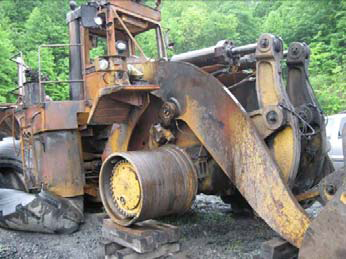
Two recent fires occurred that involved front-end loaders. These fires proved very dangerous to miners and fire fighters because the off-road tires exploded, resulting in a dangerous release of energy. Large off-road tires can throw debris 900 feet when they explode. Although the exploding tires did not injure anyone during these accidents, one front-end loader operator received burns and injuries when he jumped from the loader

Click here for: Safety Flyer (pdf)